Stainless Steel Jewelry Benchmarks: Lead Times & MOQ
When buyers compare quotes for stainless steel jewelry or custom jewelry boxes, the numbers that confuse them most are lead time and MOQ. "Why does one supplier say 45 days and another says 25? Why is the minimum 500 here and 100 there?" The answers are not random — they follow a predictable structure once you understand how this category is actually made. The figures below come from our own production records in the Pearl River Delta cluster, and they make a useful planning baseline for any buyer sizing an order.
Custom jewelry box production runs about 20 days for sampling and 45 days for bulk after sample approval. Stainless steel jewelry samples in roughly 15 days, with bulk also near 45 days. Minimums are 100 pieces per design for jewelry and 500 per color per style for boxes — a small run is not automatically the cheaper option.
Lead-time benchmarks
Bulk timelines are similar across the two lines; sampling is where jewelry and boxes differ.
| Product | Sampling | Bulk production |
|---|---|---|
| Custom jewelry boxes | ~20 days | ~45 days |
| Cast / molded stainless steel pieces | ~15 days | ~45 days |
| Rings and other no-mold items | ~15 days | ~45 days |
| Simple beaded jewelry | ~15 days | ~25 days |
Metal jewelry sampling runs around 15 days: confirming materials, proofing the finish, and aligning on quality before a line runs. Custom boxes take closer to 20 days to sample because the structure, materials and die work need longer proofing. Bulk at 45 days covers procurement, production scheduling, finishing, QC and packing on both lines. The exception is simple beaded styles, where there is no casting or complex finishing, so bulk can land near 25 days.
These are typical planning numbers, not contractual guarantees — a specific order's timeline depends on material availability and the factory's current load.
How MOQ really works
Minimum order quantity is not a single number for this category. It is calculated per order, and the logic differs by product type.
- Jewelry boxes: MOQ is generally 500 pieces per single color and single style. Adding a second color or a second style is a separate run.
- Cast or molded stainless steel jewelry: because a mold must be made, the MOQ is usually 500+ pieces so the mold cost can be spread across the run.
- Rings and other no-mold items: typically 100 pieces per ring size, with the option to apply multiple surface treatments or colors across that quantity.
So when a supplier quotes MOQ, what they are really quoting is the lowest economical batch for that specific construction. A ring in one size can start at 100; a cast pendant almost never can.
The "100 pieces also" trap
A buyer will occasionally find a supplier who agrees to 100 pieces on an item that normally needs a mold. That is not a special favor — the mold still has to be made. In those quotes, the cost of the mold (effectively the equivalent of ~500 blank embryos) is already absorbed into the per-unit price. The order is smaller on paper, but the buyer is paying for the mold either way.
The practical takeaway: compare true unit economics, not just the headline MOQ. A low MOQ with mold cost baked in is often more expensive per piece than a straightforward 500-piece run.
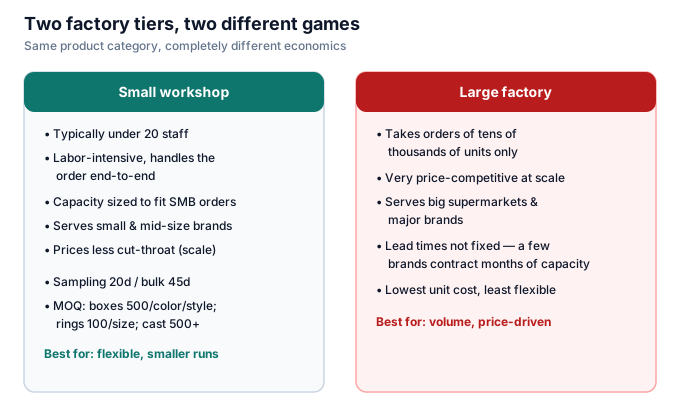
Two factory tiers, two different games
This is the part most buyers miss. Within the same product category there are effectively two kinds of supplier, and they are not interchangeable.
Small workshops — often under 20 staff — are labor-intensive operations that handle an order from assembly through QC to packing and shipment. Their capacity is sized to absorb exactly the kind of orders small and mid-size brands place, which keeps them flexible. Their prices are not the most aggressive on the market, because they do not have the scale to squeeze unit cost the way a volume plant can.
Large factories take only orders of tens of thousands of units and upwards. Their unit prices are genuinely competitive at that scale. They supply big supermarkets and major brands. Their lead times are not fixed in the same way, because a small number of large buyers routinely contract months of their capacity at a time.
Neither tier is "better" in the abstract. A small brand needing 500 boxes gets a far better fit from a small workshop; a retailer needing 50,000 units at the lowest cost needs the large factory. The mistake is quoting one tier against the other as if they were the same business.
For context on why so many "factories" online are actually single-link workshops or trading companies, see the truth about stainless steel jewelry manufacturing.
All of these figures are pulled together in one place — the Stainless Steel Jewelry & Box Sourcing Benchmark.
Frequently Asked Questions
How long does jewelry box production take? Sampling typically runs about 20 days and bulk production about 45 days for a custom box, based on standard practice in the Pearl River Delta cluster. Metal jewelry samples faster, around 15 days, and simple beaded styles can complete bulk in roughly 25 days.
What is a typical MOQ for stainless steel jewelry? It depends on construction. Jewelry boxes are usually 500 pieces per single color and style. Cast or molded pieces need 500+ to amortize the mold. Rings and similar no-mold items start around 100 pieces per size.
Why do some suppliers quote 100 pieces when others say 500? For molded items, a 100-piece quote usually means the mold cost (roughly the equivalent of 500 blank embryos) is already built into the unit price. The buyer pays for the mold either way — the lower MOQ just hides it in the per-piece cost.
Should I use a small workshop or a large factory? It depends on volume and flexibility. Small workshops (often under 20 people) fit small and mid-size brand orders and stay flexible, though their unit prices are less aggressive. Large factories win decisively on price for tens-of-thousands-plus runs but lock capacity around a few major buyers, so lead times are less predictable.
Ready to source this?
If you are planning a stainless steel jewelry or organizer program, contact our team with a drawing or reference sample for a quote, or browse the full catalog.
Browse our 316L stainless steel jewelry or request a quote →
Get a quote
Send the drawing, target material and volume. We reply within one business day with the MOQ, the sampling and bulk lead times for your piece, and the step each one belongs to.