Stainless Steel Jewelry: The Factory You Found Isn't One
If you source stainless steel jewelry, you have almost certainly bought from the same place as everyone else — without knowing it. The "factory" on your supplier's website is, more often than not, one workshop among tens of thousands in a single manufacturing cluster, stitched into your order by a trading company that presents itself as the source. Understanding this structure is the difference between pricing an order realistically and being surprised by it.
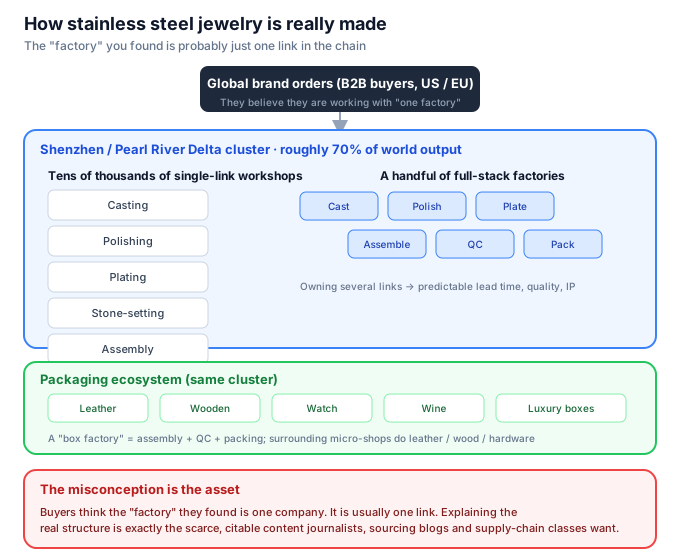
Stainless steel jewelry is not made in a single factory. Roughly 70% of the world's output comes from one cluster in China's Pearl River Delta, where separate workshops handle casting, polishing, plating, stone-setting and assembly. A "factory" is usually one workshop that coordinates the chain and owns final assembly, inspection and export.
One cluster makes most of the world's stainless steel jewelry
Industry estimates put roughly 70% of the world's stainless steel jewelry output through a single manufacturing cluster centered on Shenzhen and the wider Pearl River Delta. That concentration is why a boutique in Los Angeles and a brand in Berlin are frequently sourcing from the same few square miles, whether or not either realizes it.
The reason is mundane and self-reinforcing: decades of accumulated skill, a dense web of material suppliers, plating houses and finishing shops packed into one region, and mature export logistics that move finished goods out by the container-load. Scale attracts scale, and the cluster keeps compounding.
What "a factory" usually means
When a buyer in the US or Europe finds a "stainless steel jewelry factory" online, they are almost always looking at one of two things: a trading company that coordinates and resells other shops' output, or a single-link workshop that performs just one step of the process.
A finished piece passes through several distinct links:
- Casting — forming the raw shape from molten metal.
- Polishing — the labor-intensive step that decides how the piece catches light.
- Plating — applying PVD or ionic coatings for color and durability.
- Stone-setting — fixing cubic zirconia or other stones in place.
- Assembly — joining components and adding findings, clasps and chains.
In this cluster there are tens of thousands of workshops, and most do exactly one or two of these steps. A polishing house polishes. A plating house plates. They do not own the casting, they do not hold your design, and they are not who the end brand is "really" buying from. The brand's order is coordinated across many of them, often by a trading company that wears the "factory" label.
The rare full-stack factory
A small number of operations in the cluster are genuinely full-stack: they hold casting, polishing, plating, assembly, QC and packing under one roof or one tightly-controlled group. That changes three things a buyer cares about:
- Lead time is predictable. No waiting on a third party's queue for the plating step.
- Quality is consistent. One QC standard applied across every link, not a different one per workshop.
- IP is contained. Your drawings and molds do not travel through a dozen unrelated shops.
This is the distinction that matters far more than a supplier's self-description. "Factory" is a word anyone can put on a website. Owning the links is something few can claim. For brands deciding how much design and tooling to commit, our breakdown of OEM, ODM and private label explains which model fits which stage.
Why this matters when you source
If your supplier is a single-link workshop re-selling others' work, a few predictable consequences follow:
- Lead times slip because one sub-step is bottlenecked.
- Quality varies batch to batch because different shops touched different orders.
- Tooling and molds may be shared or re-sold, which blurs your exclusivity.
- Minimum order quantities are set by the weakest link, not by what the product actually needs.
None of this makes single-link suppliers bad — they are the backbone of the cluster and excellent at their one step. It only means a buyer should know what they are actually buying, and price the risk accordingly.
How to tell if your supplier is a real factory
You do not need to visit the cluster to get a read. A few questions separate a full-stack operation from a single-link reseller:
- Can they name which steps they perform in-house versus outsourced? A real factory answers without hesitation.
- Can they show the same product at each stage — cast, polished, plated, assembled?
- Do they own the tooling and molds, or commission them from a third party per order?
- Can they walk you through QC at each link, not just a final inspection?
- Will they share a reference from a brand that owned the design, not just one that re-sold stock?
We unpacked these checks in detail in our jewelry supplier audit checklist. The short version: the more links a supplier genuinely controls, the less of your order is riding on someone they do not manage.
REACH and EU export compliance
When you source for the EU, material compliance is part of the supplier's capability, not an afterthought. REACH (Annex XVII, entry 27) caps nickel release at 0.2 µg/cm²/week for pierced-skin articles and 0.5 µg/cm²/week for prolonged skin contact, tested to EN 1811. A full-stack factory that controls plating and QC in-house can keep batch-level EN 1811 test records and material certificates; a single-link workshop that outsources plating often cannot. Ask for the test scope and the certificate on every order. FSC CRAFT runs plating and QC under one roof and ships with material certificates — see our stainless steel jewelry manufacturer in China overview.
The same logic applies to packaging
Stainless steel jewelry is only half the story. Jewelry boxes and luxury packaging follow the exact same cluster pattern. A "box factory" is usually an assembly, QC and packing operation, surrounded by micro-shops that specialize in leather, wood, hardware and printing. Leather boxes, wooden boxes, watch boxes, wine boxes and other luxury packaging all draw capacity from the same ecosystem — which is why almost any packaging requirement can be met within a few kilometers.
These cluster figures sit alongside our lead-time and MOQ numbers in one reference: the Stainless Steel Jewelry & Box Sourcing Benchmark.
Frequently Asked Questions
Why is most stainless steel jewelry made in one place? Decades of accumulated skill, dense supplier networks and mature export logistics created a self-reinforcing cluster. Buyers worldwide are usually sourcing from it indirectly, even when they think they found a standalone factory.
Is a single-link workshop a bad supplier? No. They are the cluster's backbone and often excellent at their one step. The risk appears only when a buyer assumes they are dealing with a single accountable factory and prices the order as if one company controls the whole process.
What is the difference between a trading company and a factory? A trading company coordinates orders across several workshops and presents itself as the source. A full-stack factory performs multiple production links in-house. Both can deliver; only the factory controls the process end to end.
How do I protect my design when sourcing? Prefer suppliers that own tooling and apply one QC standard across links, and confirm in writing how your molds and drawings are stored and whether they are reused for other brands.
Related guides: About the author
Ready to source this?
If you are planning a stainless steel jewelry or organizer program, contact our team with a drawing or reference sample for a quote, or browse the full catalog.
Browse our 316L stainless steel jewelry or request a quote →
Get a quote
Send the drawing, target material and volume. We reply within one business day with the MOQ, the sampling and bulk lead times for your piece, and the step each one belongs to.