7 Checks: Real Factory or Single-Link Workshop?
When you search for a stainless steel jewelry "factory," the result is almost always one of two things: a trading company that coordinates other shops' output, or a single-link workshop that performs just one step of the process. Neither is automatically a problem — but you should know which one you are talking to before you send a deposit. Use these seven checks.
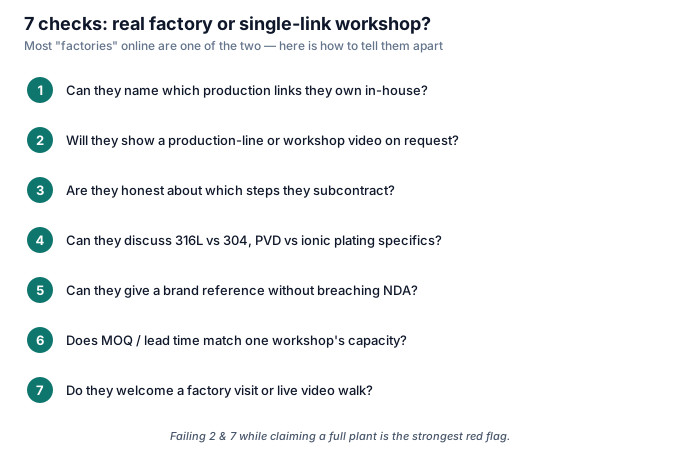
Check whether a stainless steel jewelry supplier coordinates the full production chain or only resells it. A real operator can name the stages it owns — casting, polishing, plating, stone-setting, assembly — and speak to material and finishing details directly. Traders and single-link workshops are vague about the steps they do not control. Asking specific process questions separates the two.
The 7 checks
1. Ask which production links they own in-house. A full-stack operation can name them: casting, polishing, plating, stone-setting, assembly. A single-link workshop will name one or two and be vague about the rest.
2. Request a production-line or workshop video. Genuine factories can show the floor — even a short, non-confidential clip. Traders and pure resellers deflect or stall.
3. See whether they are honest about subcontracting. Real operators say things like "we cast in-house and plate externally" without hesitation. Subcontracting within the cluster is normal. What matters is transparency, not the illusion of doing everything alone.
4. Drill into material and finishing specifics. Can they discuss 316L versus 304, PVD versus ionic plating, passivation, or finish tolerances? Deflection to a "trading department" when you ask technical questions is a tell.
5. Ask for a brand reference (without breaching NDA). Established OEM suppliers have repeat clients they can hint at without naming them. A supplier with no referencable track record is a bigger unknown.
6. Check MOQ and lead time against one workshop's capacity. For stainless steel jewelry, no-mold pieces typically start around 100 pieces per design, while cast or molded pieces usually need 500+ so the mold can amortize — with sampling around 15 days and bulk around 45 days (simple beaded styles nearer 25). Jewelry boxes are a separate line with their own economics — see the production benchmarks. Numbers wildly outside those ranges deserve a question about where the work is actually done.
7. Propose a factory visit or live video walk. Real factories welcome it. Traders find reasons to decline. A willing, transparent supplier who shows you the line is worth more than a slick catalog that hides it.
What to do with the answer
If they are a single-link workshop but transparent about it, that is workable — you are simply buying coordination across the cluster rather than vertical integration. If they claim a full plant yet fail checks 2 and 7, treat that as the strongest red flag and proceed with caution.
The broader context — why so many "factories" are really one link in a much larger chain — is explained in the truth about stainless steel jewelry manufacturing.
The MOQ and lead-time ranges that reveal a supplier's real setup are collected in our Stainless Steel Jewelry & Box Sourcing Benchmark.
Frequently Asked Questions
Is it bad if my supplier subcontracts? No. Within the stainless steel jewelry cluster, subcontracting is the normal way pieces are made. The risk is not subcontracting itself — it is a supplier who hides it or cannot account for where each step happens.
What is the single strongest red flag? Claiming to be a full factory while refusing a line video or visit (checks 2 and 7). A genuine operation is usually happy to show its floor.
Should I only work with full-stack factories? Not necessarily. Many excellent suppliers are assembly or single-link hubs that coordinate the cluster well. The goal is to know what you are buying, not to enforce a specific structure.
How do MOQ and lead time reveal the real setup? They reflect capacity. For jewelry, minimums near 100 pieces per design on no-mold items (500+ on molded pieces), with roughly 15-day sampling and 45-day bulk, match a workshop that actually produces; figures far outside that pattern suggest work is being brokered rather than made in-house.
Ready to source this?
If you are planning a stainless steel jewelry or organizer program, contact our team with a drawing or reference sample for a quote, or browse the full catalog.
Browse our 316L stainless steel jewelry or request a quote →
For a full buyers checklist, see our guide to choosing a stainless steel jewelry manufacturer in China — OEM/ODM, 316L vs 304, compliance and sampling.
Get a quote
Send the drawing, target material and volume. We reply within one business day with the MOQ, the sampling and bulk lead times for your piece, and the step each one belongs to.