Jewelry Box Cluster: Your 'Box Factory' Is an Assembly Hub
If you source custom jewelry boxes, you have probably been quoted by a "box factory" that also offers wooden boxes, watch boxes, and even wine or perfume packaging. That range is not a coincidence, and it is not a vertically integrated plant. The reason one supplier can quote such unrelated product types is the part most buyers never see — and the part that sets your lead time and quality.
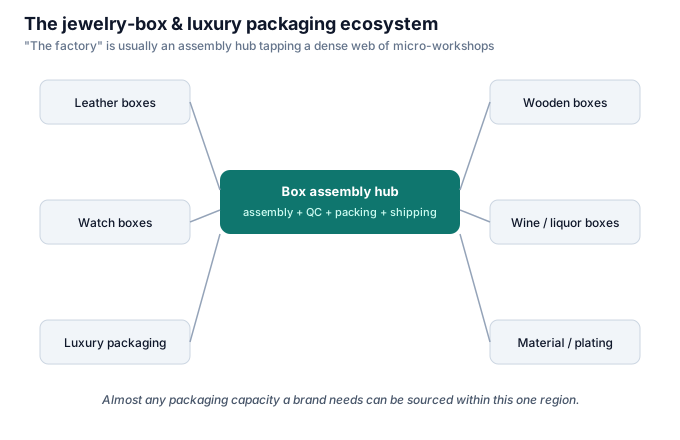
A jewelry box "factory" is usually an assembly hub, not a single plant. It coordinates a web of micro-workshops that make the leather wrap, wood shell, insert and hardware, then handles assembly, QC, packing and shipping. That is why one supplier can offer boxes, watch cases and other packaging — they share the same local network.
What a box "factory" actually does
A jewelry-box supplier's core work is assembly, quality control, packing, and shipping. The structural and decorative pieces — the leather wrap, the wood shell, the insert, the hardware — are produced by separate small workshops and pulled together at the hub. This is why one supplier can credibly offer boxes alongside seemingly unrelated packaging: they are all reachable through the same local network.
This mirrors the structure of stainless steel jewelry manufacturing itself, where finished pieces are the output of many single-link workshops stitched together. See the truth about stainless steel jewelry manufacturing for the wider pattern.
The surrounding micro-workshop ecosystem
Around the assembly hub sits a dense set of specialized small workshops:
- Leather box workshops — wraps, trays, and cases in various finishes.
- Wooden box workshops — solid and veneer shells, watch and cigar-style boxes.
- Watch box makers — padded compartments and precise inserts.
- Wine and liquor box makers — rigid, often magnetic-closure presentation boxes.
- Broader luxury packaging — cosmetic, gift, and boutique presentation.
- Material, plating, and finishing suppliers — the inputs and surface treatments everything draws on.
The practical result: almost any packaging capacity a brand needs can be sourced within this one region. A buyer is rarely limited by what a single "factory" lists on its website — they are limited by how well the hub coordinates its network.
Why this matters for buyers
- One supplier, many packaging types. A hub that assembles jewelry boxes can usually also source watch, wood, or liquor boxes through the same ecosystem. Treat the website catalog as a sample, not a ceiling.
- Lead times follow the assembly model. Sampling and bulk timelines track the hub's coordination load, not a single plant's output. Typical figures are ~20 days sampling and ~45 days bulk for boxes — see the production benchmarks.
- Capacity is shared and finite. These are labor-intensive operations. A hub's capacity is sized to the orders it regularly runs, which is why very large, fixed-volume buyers often contract capacity directly with bigger plants.
- Honesty is a positive signal. A supplier who openly says "we assemble and subcontract the wood shell" is usually more reliable than one who implies they carve every part in-house. Subcontracting within the cluster is normal; pretending otherwise is not.
The box cluster and the jewelry cluster share the same logic; both are summarized with lead times and MOQs in the Stainless Steel Jewelry & Box Sourcing Benchmark.
Frequently Asked Questions
Is a jewelry-box "factory" really a factory? Usually it is an assembly and QC hub. The components are made by surrounding micro-workshops and brought together at the hub for finishing, inspection, packing, and shipping.
Why can one box supplier also offer watch, wood, and liquor boxes? Because those product types are all made by specialized workshops inside the same packaging cluster. The hub coordinates them rather than manufacturing each in one plant.
Does subcontracting mean lower quality? Not by itself. Subcontracting within a dense, specialized cluster is the normal way boxes are made. Quality depends on the hub's QC and coordination, not on whether every step happens under one roof.
How long does custom packaging take? A typical pattern is about 20 days for sampling and about 45 days for bulk production, though simpler constructions can run shorter. Exact timing depends on material availability and the hub's current load.
Ready to source this?
If you are planning a stainless steel jewelry or organizer program, contact our team with a drawing or reference sample for a quote, or browse the full catalog.
Browse our jewelry boxes & organizers or request a quote →
Get a quote
Send the drawing, target material and volume. We reply within one business day with the MOQ, the sampling and bulk lead times for your piece, and the step each one belongs to.