The Humanization Evolution of Modern Leather Jewelry Boxes
Modern leather jewelry boxes have stopped being passive containers. The change is easiest to see in three scenes: a traveler pulling a passport-sized case from a handbag, a dresser-top box that rotates to put each compartment within reach, and a storage box that watches its own interior humidity.
The problem the old box could not solve
A single-compartment velvet box holds everything and protects nothing. Necklaces tangle, earrings slip into gaps and vanish, and a larger bracelet simply does not fit the fixed grid. Oxidation adds a slower failure: silver and lower-karat gold dull in damp, still air, and a soft lining does nothing about it. Most disappointing boxes fail on these three points before any question of style arises.
Travel: small, sorted, cushioned
The travel case is where the redesign is most visible. A case the size of a passport unfolds into separate zones: a card slot for earrings, a channel for one ring, an elastic pocket for fine chains, so nothing crosses or knots. Leather's own flex cushions pieces against the pressure of a packed bag. Variants follow use: rugged vegetable-tanned leather that takes on a patina, oil-treated leather for beach trips, a folding style that lies flat on a hotel vanity.
On the dresser: rotation and modules
At home, the rotating case turns organization into one motion: fan-shaped compartments on a quiet bearing, each with its own lining, so selecting jewelry no longer means digging. Modular interiors matter more than the spin, though. Compartments that add or remove let the same box grow from a three-layer starter to a collector's setup, and details like a leather-wrapped mirror at the right angle for earrings show where the real design work sits.
Protection beyond padding
The newer protection features target the environment inside the box rather than impacts from outside. Humidity sensors that trigger a small dehumidifying module protect silver from tarnish and pearls from mold, low-blue LED lighting shows true color without bleaching stones, and silver-ion linings inhibit bacteria physically rather than chemically. None of this replaces the basics; it sits on top of a box whose layout already works.
What to specify instead of admiring
Scene descriptions sell boxes, but a buyer can order every useful idea on this page: interior layout, lining material per compartment, closure type, mirror placement, and whether humidity control is wanted at all. Send those four decisions to a manufacturer and the "humanized" box stops being marketing language and becomes a build sheet.
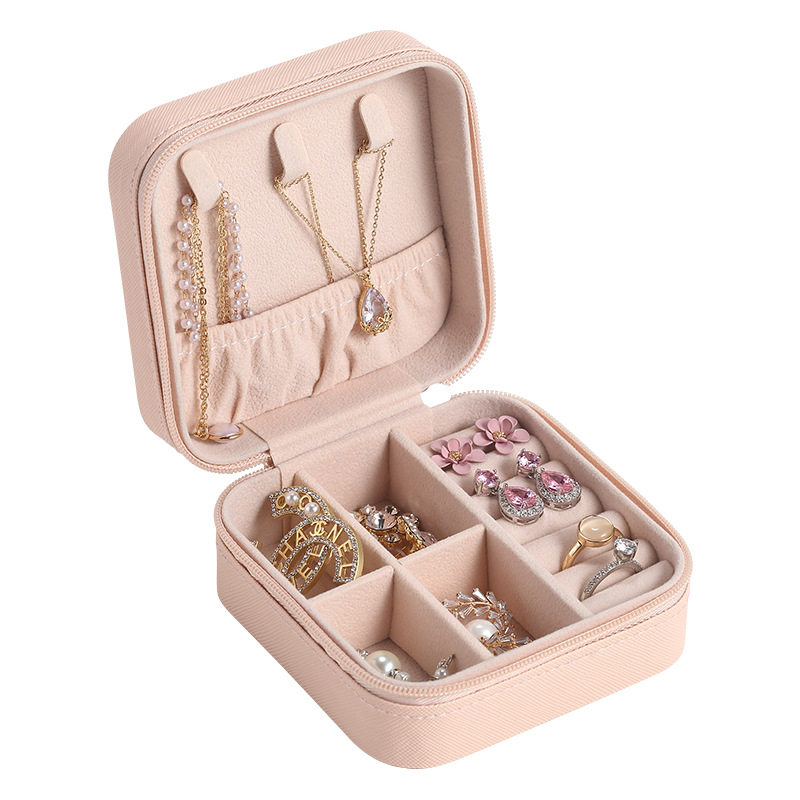
Feature → spec mapping
Scene language sells boxes, but every useful idea on this page is orderable. Turn the marketing into a build sheet.
| Feature | What to specify | Why |
|---|---|---|
| Travel case | Separate earring/ring/chain zones + padding | Pieces never cross or knot |
| Rotating dresser box | Modular compartments over the spin | Grows with the collection |
| Silver / pearl care | Humidity control or sealing closure | Stops tarnish and mold |
| Mirror placement | Angle suited to earrings | Daily usability |
Send those four decisions to a manufacturer and the "humanized" box becomes a specification instead of a slogan.
Frequently asked questions
What makes a travel jewelry case actually usable?
Separate zones that keep pieces from touching: card slots for earrings, a channel for rings, pockets for chains, with enough padding that a packed bag cannot crush the contents.
Are rotating jewelry boxes worth specifying?
They are worth it on a dresser where several compartments are in daily use, since selection becomes one motion. The interior modularity matters more than the rotation mechanism itself.
Which protection features matter for silver and pearls?
Humidity control above all: silver tarnishes and pearls mold in damp, still air. A humidity sensor with a small dehumidifier, or at minimum a genuinely sealing closure, addresses both.
Related guides: The new chapter of jewelry boxes brought about by the mechanical revolution in the 19th century
← The new chapter of jewelry boxes brought about by the mechanical revolution in the 19th century
Environmental Innovation Reshapes the Material Revolution of Jewelry Boxes →
Part of the jewelry storage guide. Next: how to choose a jewelry storage box.
What this means for your order
If you are still deciding, one thing decides this for you: whether the change is one you can specify - lining material, closure type and interior spacing are the three a buyer can actually put in a brief. Everything else on a quote page is presentation.
Where this falls short impossible to buy from the pictures alone; the evolution is in details that photography flattens out.
What to send us your interior layout and material preference, and we will tell you what is standard and what has to be tooled.
Ready to source this?
If you are planning a stainless steel jewelry or organizer program, contact our team with a drawing or reference sample for a quote, or browse the full catalog.
Browse our jewelry boxes & organizers or request a quote →
Get a quote
Send the drawing, target material and volume. We reply within one business day with the MOQ, the sampling and bulk lead times for your piece, and the step each one belongs to.