Lost-Wax Casting for Steel Jewelry
Casting is the molten art of stainless steel jewelry, a raw and powerful rebirth of complex beauty.
When design breaks free from the constraints of geometry, and when form transcends the boundaries of machining and stamping, a passionate ultimate craftsmanship takes the stage – stainless steel precision casting. It uses molten steel at 1600℃ as the ink, and ceramic molds as the mold, solidifying the unrestrained and complex designs into wearable metallic realities. This is the "reverse runner" of efficiency, the "ascender" of cost, yet it is also the ultimate answer for stainless steel jewelry to break through the limits of form, carrying the magnificent collaboration of industry and art in the furnace.
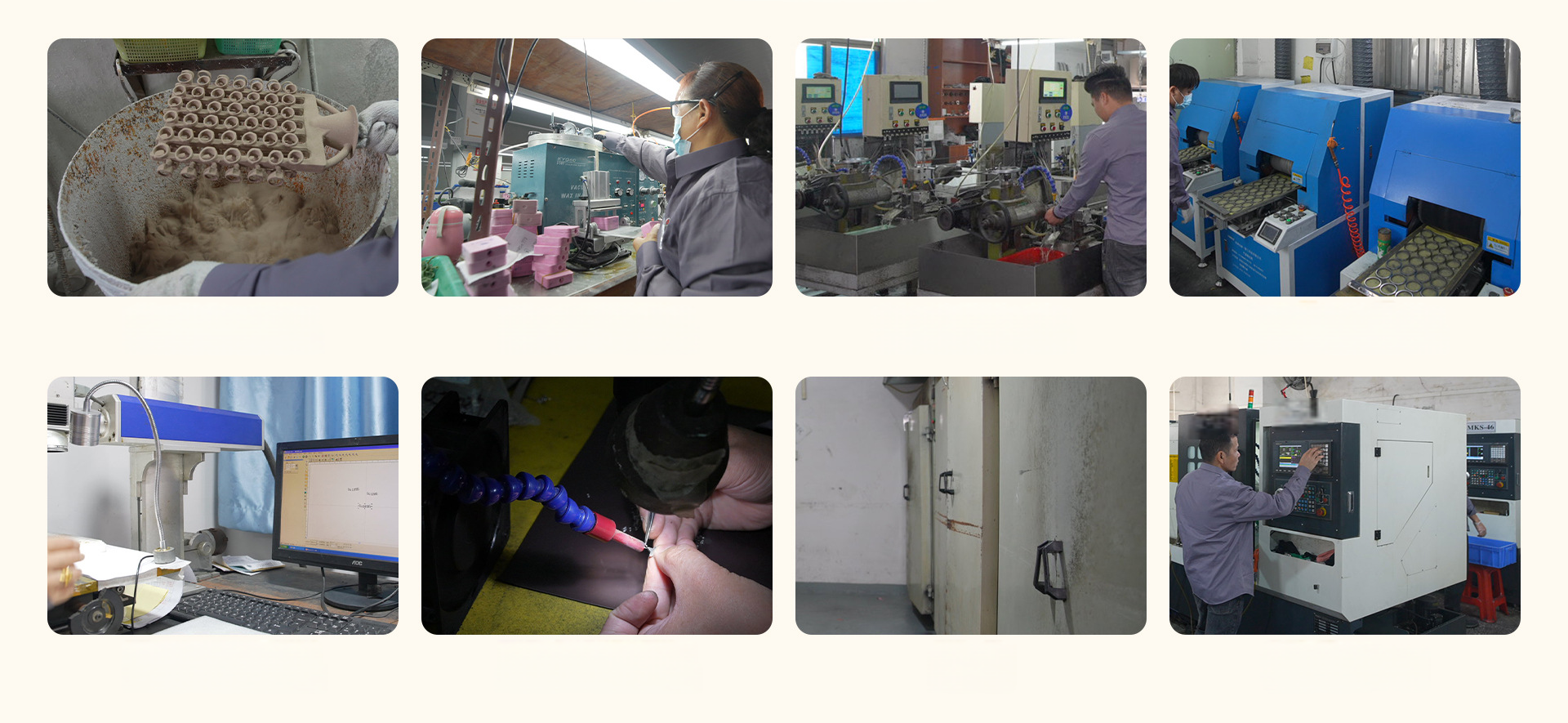
What casting adds to a piece
What casting adds to a piece
The essence of casting is to pour molten metal into a mold cavity, allowing it to cool and solidify to form the desired shape. However, when applied to stainless steel jewelry, the difficulty increases exponentially:
The high-temperature quenching (1500 – 1600℃) has a much higher melting point than gold and silver (~1000℃), requiring specialized equipment such as medium-frequency induction furnaces, and poses severe challenges in terms of energy consumption and safety control.
It is much higher than carbon steel (1.5 – 2.0%), which can easily lead to shrinkage cavities, hot cracks and dimensional deviations, and places extreme demands on the design of the secondary pouring system.
At high temperatures, chromium elements are prone to oxidation, and improper control of the slag will result in inclusions, damaging the integrity of the jewelry surface.
The stainless steel melt has high viscosity and poor fluidity, making it difficult to perfectly fill fine structures.
Investment casting and the ceramic shell
Investment casting and the ceramic shell
The investment casting method (Investment Casting) is the main process for creating 3D printed wax molds or metal resin molds → applying multi-layer ceramic slurry → high-temperature dewaxing and firing (at 900°C+) → obtaining high-precision ceramic molds. The replication quality is excellent (CT4-CT6 level), with surface detail resolution ≤ 0.1mm.
Silica sol + electrofused corundum, with high-end configuration, the mold has high high-temperature strength and low thermal expansion coefficient, reducing the reaction between metal and mold, ensuring a smooth surface.
Melt the 316L stainless steel base material in an argon gas or vacuum environment to prevent oxidation and improve the purity of the molten steel.
The high-speed rotating centrifugal force drives the molten steel to fill the micro-angled corners of the mold cavity, significantly enhancing the filling capacity and density, making it suitable for hollow parts. Optimize the pouring riser system to ensure sequential solidification, concentrating the shrinkage defects in the riser, and improving the quality of the main body.
Low carbon (≤ 0.03%) reduces the intergranular corrosion tendency, while molybdenum (2-3%) enhances corrosion resistance and has excellent biocompatibility. For example, German 1.4408 (G-X5CrNiMo19-11-2), with optimized silicon and manganese contents, improves fluidity and is specifically developed for casting.
Precisely simulate the flow and solidification process of molten steel, as well as the location of shrinkage cavities, optimize the design of the pouring system, and reduce the cost of trial and error.
The designer uses ZBrush and Rhino to create extremely complex models (with hollow nesting, organic surfaces, and fine textures).
The wall thickness is uniform (≥0.8mm to avoid breakage) and sharp internal corners are avoided (R angle ≥ 0.5mm to prevent stress cracking) and the draft angle is reasonably designed (although a draft angle of zero is possible, it affects shell removal).
High-precision prototypes (with a layer thickness of 0.025 – 0.05mm) are produced through UV curing (SLA) or wax jetting (MJ) printing.
Multiple wax molds are welded to the central runner to form a "wax tree", maximizing the output per furnace.
The wax tree group was immersed in a silica sol + ultrafine zirconium oxide powder slurry (particle size ≤ 10 μm). It was reinforced with fused alumina sand (80-120 mesh). Each layer was dried and hardened, resulting in a final shell thickness of 3-8 mm. The wax was removed by steam at 150-200℃ → fired at 900℃ to remove residual wax and sinter the shell.
Vacuum melting of 316L stainless steel ingot (at 1600℃).
Steel water is injected into preheated mold (by centrifugal or gravity casting).
Molding temperature (1550 ± 20℃), mold temperature (≥ 700℃).
The vibration shell removal machine removes the ceramic shell.
The water jet or laser cutting separates the casting from the gate.
The corundum sand removes the surface sintering layer, revealing the metallic texture. The nitric acid and hydrofluoric acid mixture removes the oxide scale and rebuilds the passivation film (in accordance with ASTM A967 standards).
Micro grinding wheels and magnetic polishing are used to process deep holes and narrow grooves.
Laser welding repairs surface pores and shrinkage pits.
Master craftsmen use diamond files and oilstones to handle the details of curved surfaces.
After passing through abrasive belts → cloth wheels → wool wheels + diamond paste, it takes several hours to achieve a mirror finish (Ra ≤ 0.02 μm).
Smooth bone structure, petal veins, water-drop shape, break through the axisymmetric limitation of turning and stamping.
Three-dimensional interwoven vines, honeycombs, lace structures, achieve a >70% air-tightness rate, as light as a feather. Directly cast multiple components (such as chain hinge rings) that were traditionally assembled by welding directly, without seams or welding.
What comes out of the mold
What comes out of the mold
Directly carve 0.1mm-level textures (wood grain, stone texture, fingerprints) on the wax mold, achieving perfect replication.
Casting precise recessed geometric voids in the solid material, creating light and shadow traps.
Composite pouring of stainless steel with bronze and silver (requiring special interface treatment), creating a collision of colors and textures.
Casting reserved cavities, filling them with glaze for firing or melting glass in the later stage.
When a customer desires a brooch adorned with twisted branches and hollow spheres, casting is the only technique capable of achieving a sense of unity. Even though the cost of a single piece is 50 times that of a stamping part, its artistic value is irreplaceable.
The initial surface roughness (Ra ≈ 6.3 – 12.5 μm) of the stainless steel casting is much lower than that of other processes, but through extreme post-processing, it can achieve the most extreme mirror finish – this is a symbol of the process's toughness.
Casting has comprehensive advantages in the production of small-batch (less than 500 pieces) complex parts: no need for expensive molds (compared to stamping), and the freedom of shape design far surpasses machining. The 3D printing wax mold technology further reduces the prototype cost by 90%.
Laser layer-by-layer fuses stainless steel powder, completely breaking away from the limitations of molds and achieving the complexity of internal cavities (such as integral cooling channels) that traditional casting cannot reach. Challenges: The surface step effect is significant, and the post-processing cost is higher.
The casting body + CNC precision processing of key parts (such as inlay grooves) balances cost and accuracy.
Based on big data, train neural networks to predict shrinkage cavity positions in advance and optimize the pouring scheme.
Six-axis robotic arm equipped with flexible grinding heads replaces some manual polishing, overcoming complex curved surfaces.
Cast in stainless steel, this intense practice, which begins with melting and ends with a mirror finish, transforms the raw nature of metal into the most exquisite artistic expression. It breaks down the boundaries of form with temperatures of over 1,000 degrees Celsius, and redeems the dignity of light through the dedicated craftsmanship of artisans over several hours. Every winding curve and every recessed shadow is a declaration of rebellion against the logic of industrial manufacturing – when complexity becomes the belief, cost gives way to the ultimate freedom of creativity.
This is not merely a craft; it is a ceremony of the rebirth of metal: as hard as steel, it also learns to flow in the flames; cooled and shaped, it transforms into a mirror in human hands. With the assistance of 3D printing and intelligent technology, this ancient art is experiencing a new lease of life, continuously expanding the form universe of stainless steel jewelry. It is a fusion of rationality and romance, a steel poem dedicated to the beauty of complexity – only through the furnace and the grit can one achieve the soul radiance that cannot be replicated by machinery.
Frequently asked questions
How should I clean and care for Casting is the molten art of stainless steel jewelry, a raw and powerful rebirth of complex beauty.? The vibration shell removal machine removes the ceramic shell. The water jet or laser cutting separates the casting from the gate. The corundum sand removes the surface sintering layer, revealing the metallic texture. The nitric acid and hy. What materials are used to make Casting is the molten art of stainless steel jewelry, a raw and powerful rebirth of complex beauty.? Casting is the molten art of stainless steel jewelry, a raw and powerful rebirth of complex beauty. When design breaks free from the constraints of geometry, and when form transcends the boundaries of machining and stamping, a passionate ul. Can Casting is the molten art of stainless steel jewelry, a raw and powerful rebirth of complex beauty. be customized with a logo or OEM? Directly carve 0.1mm-level textures (wood grain, stone texture, fingerprints) on the wax mold, achieving perfect replication. Casting precise recessed geometric voids in the solid material, creating light and shadow traps. Composite pouring. Is Casting is the molten art of stainless steel jewelry, a raw and powerful rebirth of complex beauty. suitable for travel or as a gift? Casting is the molten art of stainless steel jewelry, a raw and powerful rebirth of complex beauty. When design breaks free from the constraints of geometry, and when form transcends the boundaries of machining and stamping, a passionate ul. How do I choose the right Casting is the molten art of stainless steel jewelry, a raw and powerful rebirth of complex beauty.? The investment casting method (Investment Casting) is the main process for creating 3D printed wax molds or metal resin molds → applying multi-layer ceramic slurry → high-temperature dewaxing and firing (at 900°C+) → obtaining high-precisio.
Part of the OEM/ODM services page: Why casting is the only route to some shapes.
What this means for your order
If you are still deciding, one thing decides this for you: how much of the finish ispolishing rather than casting: a cast blank carries gates and sprues, so thepolishing stage decides what the customer actually sees. Everything else on a quote page is presentation.
Where this falls short a poor foundation if the drawing calls for a mirror face with no visiblepolishing lines - that part should not be cast.
What to send us the structure and the weight, and we will tell you what thepolishing allowance looks like before it is finished.
Get a quote
Send the drawing, target material and volume. We reply within one business day with the MOQ, the sampling and bulk lead times for your piece, and the step each one belongs to.