Custom Jewelry Box Specs: What to Set Before a Quote
Two quotes for the same jewelry box can differ by a factor of two, and neither supplier is wrong. What happened is that one buyer specified a 100 × 100 mm rigid box with a foam insert and the other specified "a box for our pendant", and each factory priced the sentence in front of it.
This page is the missing document. It is the specification you should have ready before you contact anyone — not a comparison of who is cheapest, which is a question with no useful answer, but a list of the decisions that silently set the price.
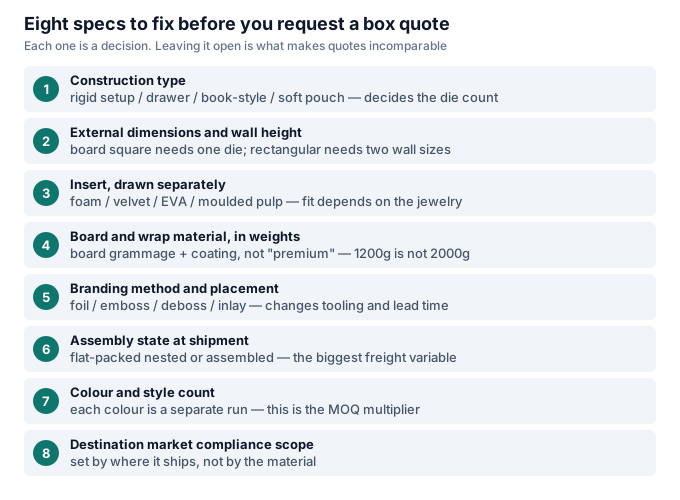
1. Construction type
This is the first fork, and it is larger than most buyers expect. A rigid two-piece setup box, a drawer box, a book-style box and a zippered soft pouch are not variations of the same product — they share no tooling and no process route.
A square rigid base is the cheapest thing to build, and the reason is worth knowing: its four walls are the same part, so one drawing serves all four and a square footprint needs a single die. Move to a rectangle and you now have two wall sizes and a second die. A drawer box adds a sleeve and a separate tray. A soft pouch is a different workshop entirely, working in textiles rather than board.
Decide this before anything else, because it changes the number of tools, the number of suppliers involved, and the price per unit by more than any material choice.
2. External dimensions and wall height
Specify the outside, in millimetres, and give the wall height separately from the footprint. Boxes get quoted on the internal size and the difference is absorbed silently into the price.
Wall height deserves its own line because it is the dimension buyers most often leave open, and it is where insert depth and jewelry clearance get decided. A 35 mm-deep box and a 60 mm-deep box of the same footprint are different products, and the deeper one changes what the insert can hold.
If you are starting from nothing, printable dieline templates for the four standard constructions exist so you can work from real panel sizes rather than describing one in prose — see free jewelry box dieline templates.
3. The insert, drawn separately
This is the single most-skipped item in a jewelry box specification, and skipping it is expensive.
The insert is not part of the box. Foam, velvet, EVA and moulded pulp each need their own drawing, and each is made by a different workshop. More importantly, the insert's fit is determined by the jewelry, not by the box — a cutout sized to a ring in the sample can be wrong for the same ring in a different size, and a slot that holds a pendant neatly can leave a chain pinched.
Write the insert as a separate line with its own material, its own dimensions, and its own tolerance conversation. "With a velvet insert" is not a specification.
4. Board and wrap material, in weights
"Premium board", "quality PU", "solid wood" — none of these are specifications, and each of them has a wide range of interpretations behind it.
What to write instead: board grammage and coating for the structural parts, and for wrapped surfaces the material plus its thickness and finish. 1200 g and 2000 g board are different products with different costs, and a wrapped shell has a substrate that also has to be stated.
The material comparison across velvet, acrylic, wood and PU is on jewelry box materials, and the failure modes of each are worth reading before choosing rather than after.
5. Branding method and placement
Foil stamping, embossing, debossing and inlay are not interchangeable — they use different tools, different setup, and differ in how they wear over a year of shipping.
State the method, the dimensions of the impression, and where on the box it sits. If the logo appears on the insert as well as the lid, that is a second operation and should be a second line. Debossing on a wrapped surface also interacts with the wrap, which is worth raising early because it is a common late change that triggers a new sample.
6. Assembly state at shipment
The same box, unassembled and flat-packed nested, occupies a fraction of the freight of the same box shipped assembled. This is frequently the largest single difference in landed cost between two otherwise identical quotes, and it is decided at the quotation stage rather than at the port.
State it explicitly: nested flat-pack, or assembled and individually boxed. Then state the retail packaging separately, because "individually boxed" and "retail-ready with a printed sleeve" are different again. Jewelry box packaging specs that drive freight covers that variable in detail.
7. Colour and style count
For custom boxes the minimum is generally 500 pieces per single colour and per single style, which means the real minimum for your project is 500 multiplied by the number of colour-and-style combinations you want. A second colour is a second run with its own setup.
Buyers sometimes find a supplier willing to go lower on a moulded item. That is not a concession — the tooling still has to be made, and in those quotes the mould cost is already absorbed into the per-unit price, so the smaller run costs more per piece than a straightforward full run would. The jewelry box MOQ explanation covers the arithmetic, and why custom boxes sit at 500 covers why the floor is there in the first place.
8. Destination market and its compliance scope
Which standard applies is set by where the box ships and how it is used, not by what it is made of. A retail display element, a component packed with a product, and a box that travels with the jewelry are three different compliance questions.
Write down the destination market and the product it ships with, and ask which documents apply to that combination. Asking for a generic certificate list produces certificates that do not cover your SKU. Green claims on jewelry packaging covers the specific wording that tends to overstate what a material actually is.
Turn the specification into a quote request
Once these eight are written down, the same document goes to every supplier on your list, and the replies become comparable — because they are now answering the same eight questions. Differences in price that remain are real differences in structure, material or capacity, and worth investigating. Differences that vanish are usually a supplier quoting a different product than the others.
Why the calendar follows the specification
Two lead-time figures cover most custom box work: roughly 20 days for a first sample and roughly 45 days for bulk production, with simpler constructions running shorter. Those numbers assume a complete specification at the point of enquiry.
Every unspecified item is a question that has to be answered before work can start, and each one pushes the sample date. This is why two buyers can send the same day and receive samples three weeks apart, and why the fastest supplier to reply is not always the one that delivers first — why custom jewelry box samples take as long as they do covers where the time actually goes.
A related point on capacity: whoever quotes your order may be an assembly hub coordinating specialist workshops rather than a single plant, and that is the normal structure in this cluster rather than a warning sign. The jewelry box packaging cluster explainer describes how that network is arranged, and the production benchmarks page covers the two supplier tiers a quote can come from — small workshops that stay flexible, and volume plants priced for tens of thousands of units.
If you are scoping a full program rather than a single box, the jewelry boxes & organizers catalog is the place to start.
Frequently Asked Questions
How do I write a jewelry box specification if I have no drawing? Start from the construction type and the outside dimensions, then let the factory draw the panels. A rigid setup box with a 100 × 100 mm footprint and 35 mm walls is a well-trodden path, and printable dieline templates for the standard constructions let you describe it in real numbers rather than adjectives. The two things you should decide yourself are the footprint and the wall height, because those drive both the tooling and what the insert has to fit inside.
Should the insert be specified by the box factory or by me? You should decide the material and the fit you need; the factory draws the cutting. What you must not do is leave it as "with insert", because a generic insert will be sized for the box rather than for the jewelry, and the fit is what a customer notices when they open it. Give the factory the actual dimensions of the piece it has to hold.
How many colours can I have in one order without paying for separate runs? Each colour and style combination is its own run with its own setup, so the practical minimum scales directly with the number of combinations. If you need four colourways, ask for the price at 500 per colourway and compare that against a single colour at a higher volume — for some brands the second option is cheaper, and for others the four-way split is what makes the launch possible at all.
Does the packaging I ship in change the MOQ? It can, indirectly. Retail-ready packaging is a separate print run, and setting it up on a small quantity carries the same kind of setup cost as any other tooling. If the boxes are going to a fulfilment centre that applies its own packaging, say so, because that removes a variable the factory would otherwise have to quote for.
**What should I ask for in writing before paying a deposit? ** The eight items on this page, in writing, plus who owns the tooling and whether it is recorded in your name. A supplier who will put all of that on paper is a supplier you can hold to later. A supplier who answers in conversation is a supplier whose verbal answers will shift the next time a date moves, and the person handling your account by then may be someone else.
Before you send the enquiry
Two things make the replies usable. First, send the identical specification to everyone on your list — any deviation in the request produces a quote for a different product. Second, ask for the answer to each of the eight items in writing rather than for a single all-in price, because the eight-item reply is the part that stays useful when the order goes wrong.
If you want a starting point for the specification itself, a dieline set for the standard constructions is at free jewelry box dieline templates, and the material options are compared in jewelry box materials.
Get a quote
Send the drawing, target material and volume. We reply within one business day with the MOQ, the sampling and bulk lead times for your piece, and the step each one belongs to.