Validate a Stainless Steel Jewelry Niche Before Sourcing
Validating a stainless steel jewelry niche is not the same as validating a generic product. The material is forgiving on margins but unforgiving on customization: every custom design carries a minimum order quantity, a sampling window and a bulk lead time that your niche has to clear before it is worth pursuing. Skip that check and you will fall in love with a niche you cannot actually produce at a workable cost. Here is the sequence we see disciplined private-label sellers use.
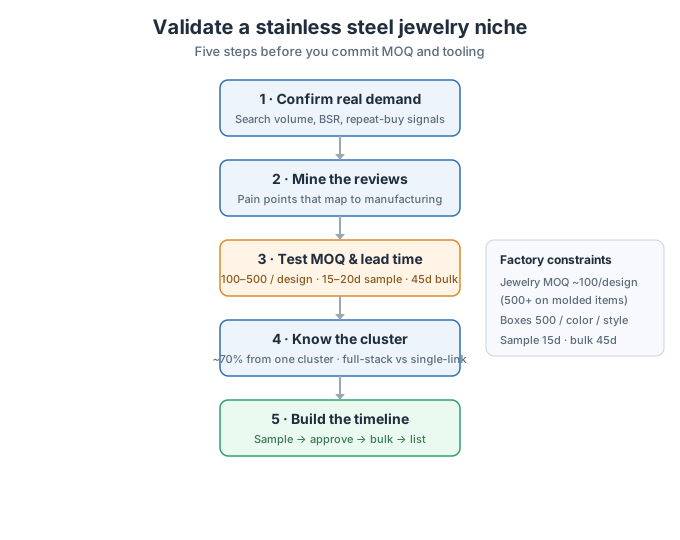
1. Confirm demand before you fall for the idea
Start with search behavior, not with a design you like. On Amazon, the signals that matter are repeatable: a category with steady Best Sellers Rank rather than a one-week spike, search suggestions that keep returning the same sub-theme (e.g. "chunky chain necklace," "magnetic clasp bracelet"), and a base of repeat-purchase reviews that hints at gifting or everyday-wear demand. A niche with thin, volatile demand will not absorb the inventory you are about to commit to.
The point is not to prove the product exists — it is to prove the sub-niche has enough consistent pull to justify a custom run. If five competing listings share the same narrow angle and all hold stable ranks, that is a healthier signal than one viral product everyone is already copying.
2. Mine the reviews like a factory
This is where stainless steel differs from, say, a phone case. The complaints buyers leave are frequently manufacturing complaints in disguise:
- "Turned my skin green" → plating or base-metal issue (PVD vs ionic, passivation).
- "Stone fell out in two weeks" → setting method, not design.
- "Clasp broke" → finding quality and assembly tolerance.
- "Color wore off" → plating thickness and hardness.
When you read reviews this way, you are really reading a specification sheet for the factory. A niche whose top complaints are all solvable at the production step is a niche you can win on quality — and quality is the one thing a trading company reselling identical stock cannot differentiate. For background on why so much stainless steel jewelry shares the same underlying supply chain, see the truth about stainless steel jewelry manufacturing.
3. Test the niche against MOQ and lead time
This is the step most sellers skip, and it is the one that decides whether the niche is real for you. Custom stainless steel jewelry runs on fixed economics:
- No-mold pieces (chains, simple stamped forms) typically start around 100 pieces per design.
- Cast or molded pieces usually need 500+ per design so the mold cost can amortize across the run.
- Jewelry boxes are a separate line with their own math: about 500 per color per style.
- Sampling runs about 15 days for jewelry and 20 days for boxes; bulk runs about 45 days, with simple beaded styles nearer 25 days.
A niche that cannot absorb 100–500 units per design at a realistic sell-through is not a custom-stainless-steel niche — it is a print-on-demand fantasy. The numbers above are the floor the cluster works to; our production benchmarks lay out the full range and what sits outside it. If your demand model needs 30 units to test the water, stainless steel custom is the wrong vehicle, and you should know that before tooling up.
4. Know the cluster you are buying from
Roughly 70% of the world's stainless steel jewelry moves through a single manufacturing cluster centered on Shenzhen and the wider Pearl River Delta — an industry estimate, not a census, but the concentration is real and it shapes everything downstream. The practical consequence: the "factory" on a supplier's homepage is usually either a trading company coordinating other shops, or a single-link workshop performing one step (casting, polishing, plating, setting, assembly).
Neither is automatically bad, but they behave differently on consistency and IP containment. A full-stack operation that owns casting, polishing, plating, assembly, QC and packing under one roof gives you predictable lead times and one QC standard; a single-link hub is excellent at its one step but coordinates the rest across the cluster. The seven-question check in how to tell if your supplier is a real factory turns that distinction into something you can verify before sending a deposit.
5. Build the timeline before you list
The mistake is listing on a date you picked from a launch course, then discovering the factory clock does not agree. A realistic stainless steel private-label timeline runs sample-first:
- Sampling — about 15 days (jewelry) or 20 days (boxes) after the dieline or artwork is confirmed.
- Your approval — however long you take to sign off the physical sample.
- Bulk — about 45 days (beaded nearer 25), then freight and clearance on top.
- List — only after the approved sample exists, so your photos and claims match the product.
Line up your Amazon launch prep — listing copy, initial PPC, Vine enrollment — to run during the bulk window, not before sampling is done. The full RFQ-to-shipment sequence is broken down in how long a jewelry order takes, and the reason sampling itself takes the time it does is explained in why jewelry sampling takes 15 days. For packaging specifically, selling jewelry on Amazon and Etsy: packaging and bundles covers what the marketplace actually expects at the box level.
The short version
Validate demand, then mine reviews for manufacturing pain points, then — and only then — test the niche against the hard floor of MOQ, lead time and cluster structure. A niche that survives all three is one you can source, differentiate on quality, and list with a timeline that holds. One that collapses at step three was never a custom-stainless-steel opportunity to begin with.
Frequently Asked Questions
What MOQ should I expect for custom stainless steel jewelry? For no-mold pieces, around 100 pieces per design is the typical floor. Cast or molded pieces usually require 500 or more per design so the mold cost spreads across the run. Jewelry boxes are separate and run about 500 per color per style.
How long before I can list a custom piece on Amazon? Plan for sampling first — about 15 days for jewelry or 20 days for boxes — then your approval time, then about 45 days of bulk production (simple beaded styles nearer 25), then freight and clearance. Listing copy and PPC can be prepared during the bulk window, but the listing itself should go live only after the approved sample exists.
Does it matter if my supplier is a single-link workshop? Not necessarily. Single-link hubs are the backbone of the cluster and often excellent at their one step. What matters is that they are transparent about what they own in-house versus what they coordinate. A full-stack factory gives more consistent QC and better IP containment; a transparent single-link hub is perfectly workable if you know what you are buying.
How do I know a stainless steel jewelry niche has real demand? Look for steady Best Sellers Rank rather than a one-week spike, repeated search suggestions around the same sub-theme, and a base of repeat-purchase reviews. Stable ranks across several competing listings in the same narrow angle are a stronger signal than a single viral product everyone is already copying.
Ready to source this?
If you are planning a stainless steel jewelry or organizer program, contact our team with a drawing or reference sample for a quote, or browse the full catalog.
Browse our 316L stainless steel jewelry or request a quote →
Get a quote
Send the drawing, target material and volume. We reply within one business day with the MOQ, the sampling and bulk lead times for your piece, and the step each one belongs to.