Caring for 316L Jewelry: Cleaning and Storage
316L stainless steel is the workhorse of modern jewelry for a reason: it resists rust, it is comfortable against the skin, and it shrugs off daily wear better than silver or plated brass. But "low-maintenance" is not the same as "no maintenance." A small routine keeps the finish bright for years, and a few avoidable mistakes are what actually dull or scratch most pieces.
This guide is written from the factory floor. We make 316L stainless steel jewelry in volume, so the advice below is about what the metal actually does — not marketing.
Why 316L needs (a little) care
316L is an austenitic stainless grade with molybdenum added for corrosion resistance. In normal air it forms a passive chromium-oxide layer that protects the surface. That layer is self-healing as long as it is not stripped or contaminated. Care is really about protecting that layer:
- Everyday oils and skin residue sit on the surface and, with perfume or sunscreen, can leave a film that reads as "dull."
- Chlorine and strong chemicals attack the passive layer and can cause pitting — the one thing 316L is genuinely vulnerable to.
- Abrasion from rough cloths or harsh pastes scratches the polish, and a scratched surface shows residue more easily.
None of this means the jewelry is damaged. It means the shine needs occasional restoring. The good news: restoring it is cheap and takes two minutes.
The 2-minute cleaning routine
For pieces worn daily, a quick clean every couple of weeks is enough. For pieces worn less often, clean them before storing.
What you need
- Warm (not hot) water
- A drop of mild dish soap
- A soft toothbrush or a microfiber cloth
- A clean, lint-free towel
Steps
- Mix warm water with a small amount of mild soap.
- Soak the piece for 30–60 seconds — long enough to loosen residue, not long enough to matter to the metal.
- Gently brush textured or engraved areas with the soft toothbrush.
- Rinse under clean running water to remove all soap.
- Pat dry with the towel, then finish with the microfiber cloth to bring back the polish.
That is the whole routine. No jewelry cleaner, no ultrasonic machine, no silver dip. Soap and water remove essentially everything that accumulates in normal wear.
What to avoid
This is the short list that actually causes problems:
| Avoid | Why |
|---|---|
| Chlorine (pools, hot tubs, bleach) | Chlorine breaks down the passive layer and can cause surface pitting on 316L. Remove jewelry before swimming or cleaning with bleach. |
| Harsh abrasives (toothpaste, baking-soda paste, scouring powder) | These scratch the polish. They "shine" the piece by removing metal, which is the wrong way to clean. |
| Perfume, hairspray, sunscreen on the jewelry | Not corrosive to 316L, but they leave a sticky film that attracts dirt and looks dull. Apply them first, let them dry, then put jewelry on. |
| The dishwasher | Detergent is alkaline and hot, and pieces knock against other items. Hand-wash only. |
| Long saltwater exposure | Seawater is fine for a swim, but rinse and dry afterwards. Salt left to dry on the surface can etch over time. |
How to store it
Storage matters more than people expect, mostly because of what jewelry is stored with.
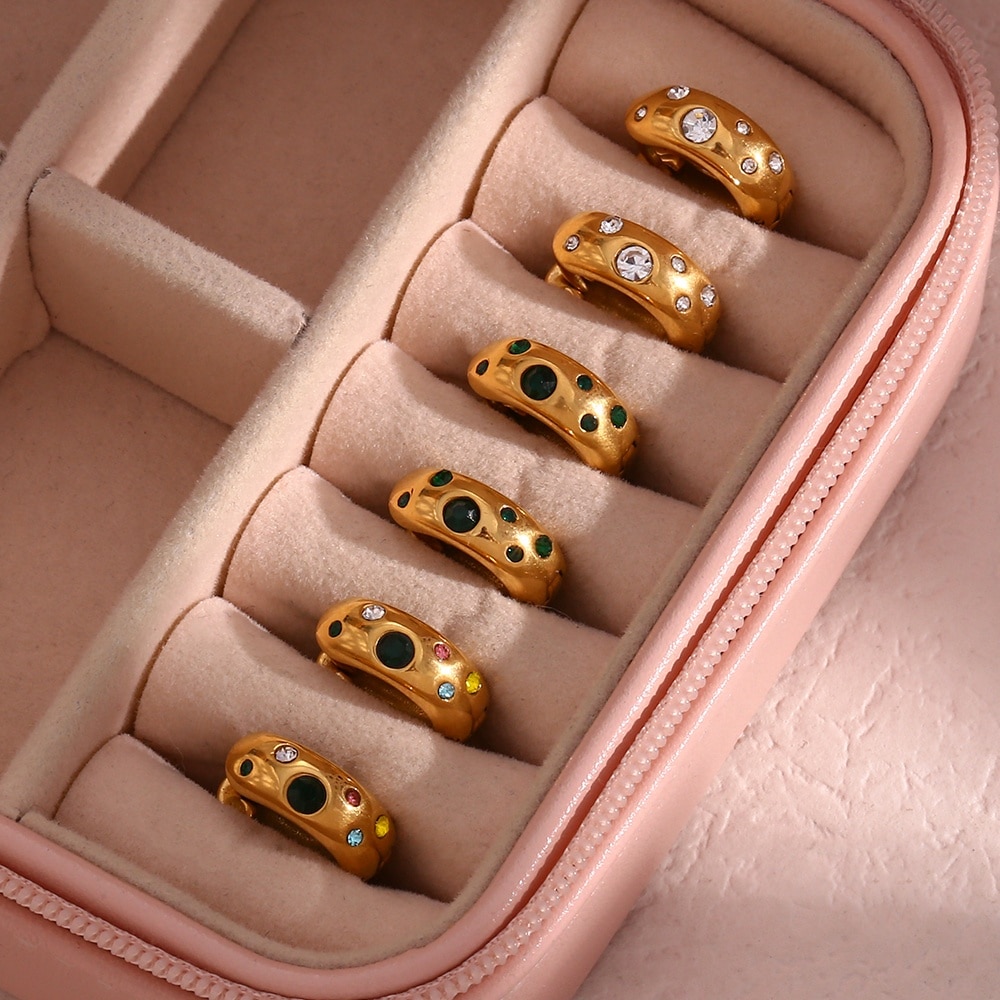
- Keep pieces separate. Stainless is harder than silver and softer metals, so it scratches them — and a tangled chain scratches itself. Use a soft pouch or a compartment.
- Avoid humidity. A closed box with a small silica sachet is ideal. The goal is to keep the passive layer dry between wears.
- Anti-tarnish strips are optional. 316L does not tarnish the way silver does, so you do not need them — but they do no harm in a shared jewelry box.
If you are sourcing packaging for a range, the insert material and slot width matter more than the box size; our free jewelry box dieline templates cover the common formats.
Restoring the shine
When a piece looks dull rather than dirty, it usually just needs polishing, not cleaning:
- Polishing cloth. A standard jewelry polishing cloth (the kind with a cleaning agent in one side) brings back the mirror finish in seconds. This is the right tool.
- What not to use. Avoid liquid "metal polish" meant for sinks or cutlery — it is too aggressive for thin jewelry and can damage any PVD color coating.
If the piece has a PVD (vacuum-plated) color coating, be gentler still. PVD is hard and wear-resistant, but abrasive pastes will eventually cut through the color. Soap, water and a soft cloth are all a PVD piece needs.
The myths, corrected
"316L never tarnishes"
Mostly true in the sense that it does not oxidize like silver. But it can develop a dull surface film from skin oils, cosmetics and hard-water residue. That is contamination on the surface, not tarnish of the metal — and it cleans off. "Never needs cleaning" is the myth; "rarely corrodes" is the fact.
"Stainless steel can't scratch"
False. 316L is around 150 HV on the Vickers scale — harder than gold or silver, but far softer than sapphire. It scratches with enough friction. The fix is the polishing cloth above, not abandoning the metal.
"Dishwasher safe"
No. Heat, alkaline detergent and physical knocking are exactly the three things to avoid. Hand-wash only.
"Hypoallergenic, so anyone can wear it"
316L is widely tolerated because its nickel is locked in the austenitic structure and released far below the EU's REACH nickel-release limit. For the vast majority of wearers it is comfortable. People with a confirmed nickel allergy should still do a patch test, because "low release" is not "zero."
"Sterling silver cleaner will make it shinier"
Avoid silver dips and creams on stainless. They are formulated for a different metal and can leave a residue or, on PVD colors, strip the coating. Soap and water, then a polishing cloth.
Care by jewelry type
- Rings take the most abuse (hand washing, gripping). Clean them a little more often, and confirm the fit — our ring size conversion chart covers US, UK, EU and Japan systems if you are reordering a size.
- Chains and bracelets tangle and self-abrade; store flat or hung, and clean in the soap bath rather than scrubbing.
- PVD-colored pieces (gold, rose, black) need the gentlest routine — soap, water, soft cloth, no abrasives.
- Earrings and studs touch the most sensitive skin; a quick alcohol-free wipe before wearing is good hygiene, then the normal routine.
Can I shower with 316L stainless steel jewelry?
Yes. Soap and water are exactly the cleaning routine, and showering does no harm. The only caveat is to dry pieces afterwards rather than leaving them damp in a closed box, which matters more for any PVD color than for the bare steel.
How often should I clean it?
Every two to three weeks for daily-wear pieces; before storage for occasional pieces. More often if you apply lotion or sunscreen over the jewelry.
Why does my stainless steel ring leave a dark mark on my finger?
That is almost always residue — soap, lotion or hard-water film — transferring from a grooved band, not the metal corroding. A proper clean with soap and a soft brush removes it. If a mark appears with a PVD-colored piece and does not wash off, the coating may be worn through at a high-contact point.
Can 316L stainless steel go in the sea?
A swim is fine. Rinse with fresh water and dry afterwards so salt does not sit on the surface. Do not leave wet salty jewelry in a closed pouch.
Is a polishing cloth enough, or do I need a machine?
A polishing cloth is enough for normal dulling. An ultrasonic cleaner is safe for bare 316L but can loosen stones in soft-set pieces and is unnecessary for flat jewelry — soap and water first.
My PVD gold piece is fading — is that normal?
PVD is durable but not indestructible. Fading at high-contact spots (inside of a ring band, clasp) over a long time is normal wear, not a defect. Avoiding abrasives slows it. If fading appears within weeks on a new piece, that points to a plating process issue worth raising with your supplier.
A note for buyers and brands
If you are stocking or specifying 316L ranges, the care story is part of the product: pieces that are easy to keep looking good generate fewer returns and better reviews. When you plan an order, the minimum order quantity and the finish (bare polished vs PVD color) should be decided together, because they change both the care instructions you pass to customers and the unit cost.
For the material basics behind this guide, see our comparison of 316L and 304 stainless steel in jewelry, and for colored finishes our explainer on PVD vacuum plating.
← Free Jewelry Box Dieline Templates (SVG Download)
Does Stainless Steel Jewelry Tarnish or Rust? The Straight Answer →
Part of the jewelry storage guide. Next: the 316L jewelry care guide.
Also answered in the FSC CRAFT FAQ: 316L against 304, tarnish, skin discolouration and care, in one list.
Everything free is on one page: the free jewelry resources hub collects every chart, calculator and template above in one list.
Frequently Asked Questions
How often should 316L jewelry be cleaned?
Only when it needs it. A piece worn daily picks up a film within a few weeks, and warm water with a soft cloth is enough. Cleaning every day is not what preserves the piece; drying it is.
What should never touch the piece?
Bleach, chlorine and anything abrasive. Chlorine is the fastest way to pit a clasp, and an abrasive cleaner takes plating off along with the dirt. Both are one-time damages that no amount of polishing undoes.
How should the pieces be stored?
Separately and dry. Two bare rings in one drawer rub against each other and wear the plating at the contact points, so a slot each is enough. Keeping them away from perfume also saves the finish.
What this means for your order
If you are still deciding, one thing decides this for you: what you wear it with rather than how often, since the marks that reach a customer come from wear and not from time. Everything else on a quote page is presentation.
Where this falls short care instructions that promise a surface stays new, because wear is how a plated finish is meant to be judged.
What to send us Tell us how the piece will be worn and we will say what care it actually needs.
For bulk programs, our guide to working with a 316L stainless steel jewelry supplier covers material grade, the hypoallergenic angle and MOQ.
Get a quote
Send the drawing, target material and volume. We reply within one business day with the MOQ, the sampling and bulk lead times for your piece, and the step each one belongs to.